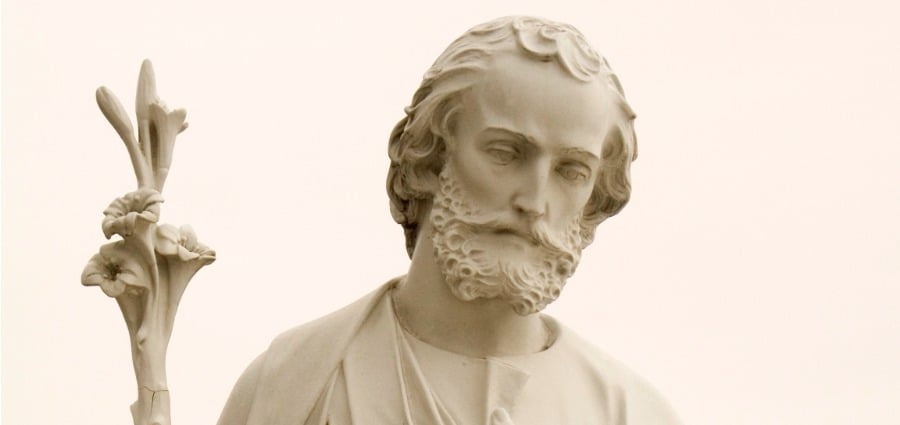
Today, we celebrate the feast of Saint Joseph. My guess is that we all know someone named Joseph, most of whom we call Joe. I’ve been blessed by knowing both good laymen and priests by that name, and each, in their own way, embody the virtue and holiness of Joseph.
I titled this homily, “Saint Joseph said ‘yes’ to God, too,” in reference to Mary’s “yes” to becoming the mother of God. Sometimes we lose track of the fact that Joseph also responded with an important yes, and I think that it’s a good reminder and example for all boys and men that it’s not just the role of girls and women to cooperate with God’s will, but it's our role as guys, too!
The Righteousness of Saint Joseph
The point of decision in the Gospel of Matthew hinges on Joseph’s righteousness and obedience to God. The term righteous would have meant that Joseph very carefully followed Jewish law. So, when he discovered that Mary was pregnant and not by him, he was compelled to divorce her.
It’s helpful to understand that at this time there was a two-step process in marriage. Unlike our engagement leading to marriage, betrothal meant that Joseph and Mary were already married through the public exchange of what we would call their vows, but they hadn’t yet begun to live together. (Today, in some cases, we have the reverse order … but that’s for another homily!)
In his righteousness, Joseph sought to follow Jewish law and divorce Mary.
Many theologians point to Joseph’s reason for quietly divorcing Mary as his mercy for her to avoid subjecting her to the shame of a public trial and a harsh sentence. Saint Thomas Aquinas and others also speak of Joseph’s humble, holy fear of not being worthy to be the adoptive father of Jesus and the husband of Mary.
The Obedience of Saint Joseph
It is at this point of decision that the angel of God appears in a dream and explains God’s plan for Joseph, Mary, and Jesus.
Joseph had a plan (according to Jewish law), but he was open to God’s plan and obediently followed it, welcoming Mary into his home, thus completing their marriage. In naming the Son of God, born of Mary, Jesus, Joseph claimed Him as his adopted son.
Whether we are named Joseph or Josephine, whether we are boys or girls, men or women, Joseph’s example of righteousness and humble obedience to God is what we are all called to live out.
At times, life gets complicated very quickly, and we can get disoriented and uncertain about what to do. Joseph is a great example of remaining calm, seeking to do what is right, and being open to the guidance of God in the moment.
May we seek to do the same and, when in doubt, call upon our role model with the words, “Saint Joseph, pray for us!”
- To view the Rosary prayer and Mass streaming live, please visit our Facebook page at 11:30 a.m. Eastern, Monday – Friday. Please invite your loved ones to join us too! (If you are not a member of Facebook and a signup window appears, simply select the X at the top of the pop-up message and continue to the livestream.)