



easter | Easter season | Family Activities | Catholic Faith
Laura Vazquez Santos explores how the Church’s fifty-day Easter season invites mothers to move from celebration to formation.
Every year, I enter the Triduum with holy ambition. I imagine dim lights, whispered prayers, and children gazing reverently at a crucifix. What I usually get is my 6-year-old asking for crackers every 5 minutes during the Gospel at Mass or my preschooler sword-fighting with last year’s blessed palm.
I admit that getting through the Easter season can be both logistically challenging and spiritually testing. In years past, and especially after my reversion to the Faith, I placed an unrealistic pressure on myself as a mother to get everything right each Easter, especially as I feared my children would be more enticed by the celebration of the Easter Bunny than by the amazing reality that is the Resurrection.
The first thing I was forced to learn was that I needed to let go of the fantasy of perfection and remember that the Lord is ready to meet me where I’m at. I had to learn that our homes are not silent monasteries and that going to Easter Sunday Mass (or any Mass for that matter) with young children is messy, stressful, and sometimes loud at the most inopportune moments. However, the graces received don’t disappear, and when we bring our imperfect selves to the sacrifice of the Holy Mass, doing the best we can as parents, that offering becomes worship too.
In this season of motherhood and faith, I find myself learning about what comes after Easter. What happens when the celebration fades? How do we live the Resurrection and sustain its hope in the ordinary demands of motherhood?
Moving from Easter Sunday to Monday Morning
The chocolate is gone, and the triumphant alleluias of Easter Sunday have passed. If you’re a mother of young children, the Easter season can feel like other holidays throughout the year — an awkward tug-of-war between cultural traditions your children naturally absorb and your desire to root them firmly in the true meaning of the celebration, reminding them that faith comes first, even when it doesn’t look as flashy or fun.
That tug-of-war eventually leads to something bigger than holiday logistics, pressing on a deeper reality which is that Easter is not meant to stay contained to one Sunday, but to shape the way we live long after the Easter Sunday celebrations have ended. And this brings us to a very practical question for mothers: Once the baskets are put away and the schedule fills back up, how do we carry Easter into everyday life? How do we keep living the Resurrection when socially we’re conditioned to not only not sit still, but to quickly move on to the next ‘celebration’ or ‘thing’?
Thankfully, the Church in her divine wisdom gives us fifty days of Easter. Not just one Sunday, rather, a season (from the Sunday of the Resurrection to Pentecost) to practice joy in the middle of laundry and Lego piles.
That tells us something important about the depth of the Resurrection and what it means for us, reminding us that the Resurrection and all that follows stretches across time because transformation takes time.
On Easter Sunday, it is easy to say, “He is risen!” The church is full (often more than usual) and there is structure to the celebration. A couple of weeks later, that feast and structure give way to reality and now kids are restless at Mass again and we’re back to the ‘status quo.’ But this is where the real work continues and the lessons and graces of Lent are [hopefully] still working within you, showing you where you are to be spiritually at that point in your faith-life. Thus, while we celebrate the feast, we should also reflect on the lessons of the season and embrace the days that follow until Pentecost, leaving room for the Holy Spirit to show us how we can carry these lessons on to our children.

In this way, the feast of the Resurrection was not meant to stay inside the church building or be confined to one day in the calendar year and then be forgotten until next year. The Church teaches that Easter is not just an event in history, but a continuing presence, and the Gospels make that clear in the way that the risen Christ did not appear once and vanish; rather, He repeatedly returned to ‘ordinary places’ in the 40 days until his Ascension.
Therefore, the way Jesus continued to appear after the Resurrection is a source of hope for mothers who may feel worn down but still choose to show up every day for their children in that same vein of sacrificial love that Jesus exemplified for us. And, because Christ keeps showing up for us, we can learn from Him how to do the same.
Making the Lessons of Easter a Daily Practice at Home
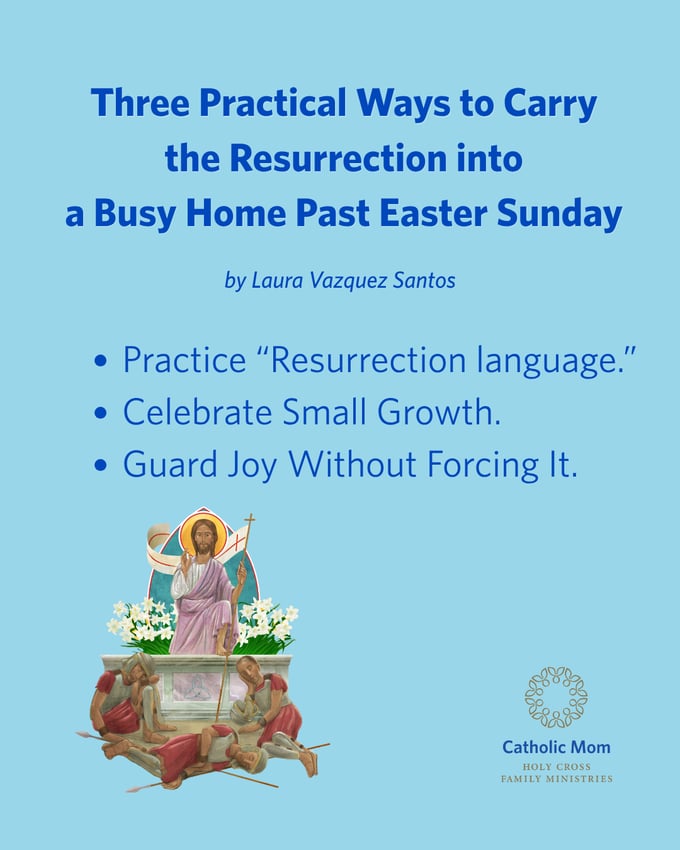
Here are three practical ways to carry the Resurrection into a busy home past Easter Sunday:
Practice “Resurrection Language”
Children absorb tone before theology, so in the next 50 days, make it a habit to narrate hope out loud.
-
When something breaks, say, “We can fix this."
-
When plans change, say, “We’ll figure it out.”
-
When someone fails, say, “Let’s try again.”
The Lord’s Resurrection teaches us that endings are not always final; we can fall and rise again with the right intentions, with hope, and with a contrite heart. Your voice at home can plant that seed of hope in your children early on.
Celebrate Small Growth
May is a month of visible change. Trees bud, gardens wake up, and the scent of a new season is palpable. Use that.
Point out new leaves. Plant something simple in a pot. Emphasize stories of beautiful transformation and growth. Tell your children, “New life and transformation take time, but what is on the other side can be so amazing.”
The Resurrection did not instantly transform the apostles into fearless saints. They grew in courage, greatly aided by the Holy Spirit at Pentecost. We, too, grow into courage and need graces to help us along the way, as do our children. Use this time to teach them how to pray for those graces to grow and be transformed into what the Lord wishes them to be.
Guard Joy Without Forcing It
Joy is one of the lessons of Easter, and it is different from fleeting happiness. Resurrection joy is steadier than emotion, and it lives quietly in the background of ordinary life. Sometimes it looks like choosing patience when you’re overstimulated, or gratitude in the middle of a difficult season. It can be as simple as turning off your phone and sitting on the floor for ten quiet minutes with your children, receiving that time as a gift, and thanking the Lord for it.
During these fifty days of Easter, we can intentionally practice this kind of joy by teaching ourselves and our children patience in moments of frustration, trusting that what feels heavy now will pass, and that God is quietly transforming us into something new and beautiful.
.png?width=680&height=680&name=FR%20FB%20Cover%20Easter%20(Instagram%20Post).png)
Fidelity After the Feast
Lastly, the disciples had to learn to live with a risen Christ they could not always see, which required trust. Motherhood requires the same. You will not always see immediate results from your efforts. You may not see the fruit of your patience, your prayers, or your small sacrifices for a long while — but the fruit is coming, and God sees it.
Each time you show up, exhausted and worn out, clinging to hope, He sees you. And just as the Resurrection transformed the disciples over time, so too will it quietly transform you and your home as you keep living its lessons long after Easter Sunday has passed.
Copyright 2026 Laura Vazquez Santos
Images: Canva